






GAZA (Gerakan Akhir Zaman), May 12, 2025 – India is increasingly shaping a global narrative that frames its conflict with Pakistan as part of a counterterrorism operation, a strategy reminiscent of Israel’s approach in its conflict with Palestine.
Linking the Attack to Militant Groups
The Indian government claims that the April 22, 2025, attack in Pahalgam, Kashmir, was carried out by militant groups based in Pakistan. Authorities have cited Lashkar-e-Taiba (LeT) and Jaish-e-Muhammed (JeM) as key actors behind the attack.
However, according to a Republika report, this attack follows a familiar pattern of India presenting itself as a victim of cross-border terrorism. Despite strict surveillance in Kashmir, including biometric checkpoints, drone monitoring, and electronic surveillance, India has failed to provide concrete evidence linking Pakistan directly to the incident.
Influencing International Opinion
India has systematically leveraged media to portray Pakistan as a state sponsor of terrorism, seeking Western political and military support.
A TRT Global report reveals that following the Pahalgam attack, Muslims in India faced heightened suspicion and social pressure, indicating that the Indian government’s narrative may be influencing domestic policies and public perception, similar to Israel’s approach in its handling of Hamas.
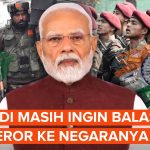
Former Indian Foreign Minister Subrahmanyam Jaishankar reinforced the narrative by stating that India has the right to defend itself against terrorist threats, a position that strengthens international legitimacy for India’s military operations in Pakistan.
Criticism of India’s Narrative
Despite growing acceptance of India’s stance among some Western nations, analysts question the validity of its claims. Republika reports that, despite India’s high-security measures in Kashmir, there is no biometric proof or CCTV footage directly linking Pakistan to the Pahalgam attack.
Global leaders continue to monitor how this narrative will impact international support for India and its broader implications for regional stability in South Asia.


